This blog will provide information relating to newer biomedical technologies/research and health alternatives. All posted articles are not to be construed as an advice to apply, use, recommend, etc. Readers should carry out independent verification or consult a specialist. No liabilities whatsoever is accepted for any loss howsoever arising directly or indirectly as a result of actions taken on ideas and information found in this blog.
Locomotion therapy supported by an automated gait orthosis on a
treadmill has shown to be an effective intervention for improving
over-ground walking function caused by neurological diseases and
injuries in many cases.
The Lokomat system assists walking movements of
gait-impaired patients and is used to improve mobility in individuals
following stroke, spinal cord injury, cerebral palsy and multiple
sclerosis as well as other neurological diseases and injuries. The
LokomatPro has been on the market since 2001 and has been a crucial
improvement in the art and science of locomotion therapy.
LokomatPro features a new and more compact design and is equipped with
the Augmented Performance Feedback and a touch screen as a standard.
Advantages of Lokomat®Pro based therapy:
longer and more intensive training sessions compared to manual treadmill training
real time feedback for a higher motivation and compliance
physiological gait pattern provided by individually adjustable orthoses, guidance force and body weight support
assessment and reporting functionality for an easy measurement of the patient’s progress
Pediatric Orthoses:
an optional add-on module offering the first driven gait orthosis for
functional and motivating locomotion therapy for small children
Information on this page is provided for interest only on a "best efforts" basis and does not constitute personal advice. Always discuss medical conditions and related matters with your doctor.
Functional Electrical Stimulation (FES) is a rehabilitation technique where electrical current is applied to an individual with a disability to enhance that person's ability to function and live independently.
FES is used to stimulate peripheral nerves, the "lower motor neurons" that connect the spinal cord to your muscles.
Stimulating these nerves evokes patterned movement of the legs or the arms. This is how FES enables your muscles to perform work even though you may have has lost all or some voluntary control of the muscles. The use of RT300-SLSA, FES system (FESS) is widely used in the international rehabilitation community. The RT300-SLSA is compact and portable and thus suited for use in places where space is a constraints. It also comes with a smart stimulation system (SAGE) which automatically saves each patient’s cycling parameters as well as performance measures at the end of each session. SAGE automatically progresses the training parameters based on patient’s performance. All the information saved by SAGE is sent via internet connection to an online portal where caregivers, therapists and patients are able to monitor the patient’s progress.
Fig - FESS, RT300-SLSA from Restorative Therapies
The FESS is an an arm and leg cycling machine coupled with functional electrical stimulation. This therapeutic device enables muscle strengthening in individuals with complete or partial loss of voluntary muscle control as a result of injury to the central nervous system, for example in spinal cord injury, multiple sclerosis and stroke.
Electrical stimulation is provided through surface electrodes placed on the patient’s skin and over selected groups of muscles in the patient’s arms and/or legs and/or trunk. Patterned electrical stimulation of the patient’s arm and/or leg muscles will enable the patient to actively propel the arm and/or foot pedals. Patients remain seated in their wheelchairs while cycling.
The use of this device will serve as an adjunct to facilitate:
Recovery of voluntary muscle control
By stimulating paralysed or weakened muscle, therapists are facilitating adaptive changes in the central nervous system (CNS) i.e. brain and spinal cord. This effect may be enhanced when the patient is performing a meaningful activity like cycling. Adaptations in the CNS may then translate into improved motor recovery.
Reduction of spasticity
When poorly controlled, spasticity can be a major hindrance to function especially when combined with muscle weakness. Optimal management of spasticity will improve patient’s mobility, function and maintenance of personal hygiene.
Increase in cardiovascular fitness
Extended periods of bed rest quickly result in reduction in the heart and lungs ability to support activity i.e. cardiovascular fitness. On admission to the rehabilitation centre, patients often tire quickly during therapy due to poor cardiovascular fitness. Increasing their cardiovascular fitness will allow patients to tolerate longer sessions of therapy.
The FES Leg and Arm bike will add to a suite of cutting-edge therapeutic services, enabling a centre to provide enhanced, evidence-based care for the patients.
Information on this page is provided for interest only on a "best efforts" basis and does not constitute personal advice. Always discuss medical conditions and related matters with your doctor.
Masimo (NASDAQ: MASI) announced today that a new study published in this month's issue of the European peer-reviewed journal Acta Paediatrica demonstrates that pulse oximetry makes a critical difference in neonatal resuscitation both in terms of reliability and speed of measurements. In comparing the measurement response times of three different pulse oximetry technologies, researchers found that the Masimo Radical-7™ pulse oximeter with Masimo SET® Measure-Through Motion and Low Perfusion technology displayed reliable oxygen saturation (SpO2) measurements three to four times faster than competing pulse oximeters.
In comparing the measurement response times of three different pulse oximetry technologies, researchers found that the Masimo Radical-7™ pulse oximeter with Masimo SET® Measure-Through Motion and Low Perfusion technology displayed reliable oxygen saturation (SpO2) measurements three to four times faster than competing pulse oximeters. 2 measurement was recorded post-ductally (one sensor placed on each foot) once an adequate pulse rate signal was displayed. Results showed that "the pulse oximeter with Masimo SET provided the fastest response time."
Despite numerous advances to improve newborn care, oxygen is still used liberally during newborn resuscitation—unnecessarily exposing many newborns to potentially damaging hyperoxia. Although pulse oximetry is an important clinical tool for evaluating a patient's oxygenation status and guiding resuscitation, measurement failure rates due to motion artifact and low perfusion can be high—leading to inaccurate readings, failure to report readings, or freezing of displayed values. As a result, the time to obtain a reliable oxygen saturation reading during newborn resuscitation in the delivery room and during NICU care is a critically important consideration when choosing a pulse oximetry technology. This is the first prospective observational study to compare pulse oximetry technology performance in detail during newborn resuscitation under unstable critical conditions.
The study was conducted at two health care centers in Barranquilla, Colombia (Clinica del Mar and Medicina Alta Complejidad S.A.) on 32 newborns (median gestational age of 32 weeks) receiving resuscitation as standard of care either in the delivery room or in the Neonatal Intensive Care Unit (NICU). Using the Masimo LNOP® sensor with the Radical-7, the E630 sensor with the Ohmeda Biox 3700, and the OxiMax Max-N sensor for the Nellcor N395, the time to a reliable SpO
In the first comparison of 17 infants, the median response time to obtain a reliable measurement for the Masimo Radical-7 was 20.2±6 (with a range of 18-26 seconds) versus 74.2±12 (with a range of 38-98 seconds) for the Ohmeda Biox 3700.
In the second comparison of 15 infants, the median response time for the Masimo Radical-7 was 20.9±4 (with a range of 19-28 seconds) versus 67.3±21 (with a range of 40-90 seconds) for the Nellcor N-395.
Finding that "there are significant differences in the response of pulse oximeters during neonatal resuscitation," researchers concluded that "the speed and reliability of the Masimo SET technology can be of help for clinicians to more accurately adjust the fraction of inspired oxygen during newborn resuscitations, thus preventing or minimizing damage secondary to unnecessary exposure of oxygen and hyperoxemia and to wide fluctuations in oxygen levels."
The 'gold standard' Measure-Through Motion and Low Perfusion performance of Masimo SET® has been shown in over 100 independent clinical studies to provide the most accurate and trustworthy measurements—even under the most challenging clinical conditions, including patient motion and low perfusion.
Crosslinking with riboflavin and UV-A light has proven to be a first-line treatment for people with corneal ectasia disorders such as keratoconus, and pellucid marginal degeneration and corneal weakness (ectasia) after LASIK.
Photo-polymerisation with the use of ultra-violet light is the most promising technique to achieve cross-linking in connective tissue. Photo-polymerisation is activated by means of a non-toxic and soluble photomediator together with a wavelength of 365 nm UV-A light source.
Fig 1, shows corneal crosslinking strengthens bonds in the stroma of the cornea, which is the layer from which tissue is removed during LASIK surgery
Fig 2, shows UV-X in use for eye treatment.
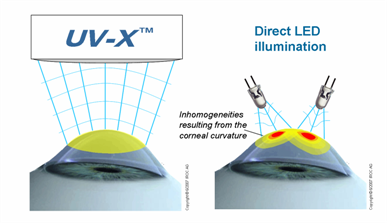
Homogeneous UV-A irradiation of the corneal is an important factor for a safe treatment procedure.Thus a homogeneous illumination of the cornea with a patented beam and optics is essential - the IROC UV-X. UV-X was developed by an experience team of researchers in collaboration with the inventors of the procedure, Prof Theo Seiler and Prof Eberhard Spoerl. It is designed with a special focus on both safety and effectivity of the procedure, embodying the cutting-edge knowledge in the field of corneal cross-linking.
Fig 3, shows Scanning Electron microscopy image of the homogenizing micro-structure used in the UV-X.
Pictures of the UV-X treatment versus the LED techniques are shown below:
Fig 4, shows UV-A versus direct LED irradiation
Fig 5, shows compensation of the corneal curvature using UV-X.
Fig 6, shows comparison of the treatment distance with reference to intensity-damage threshold.
Fig 7, shows an optical design according to Koehler's reduces the radiant exposure to retina.
Once patients have received crosslinking, in most cases their corneal shape will either remain stable or actually improve. This can provide patients with improved visual acuity and improved ability to wear contact lenses.
Some surgeons have also reported reasonable results in improving the stability of the cornea in people who have undergone radial keratotomy, an incisional refractive procedure from the 1980s and 1990s. Crosslinking appears to work best for those who are experiencing daily fluctuations in their vision.
People who are considering vision correction procedures such as LASIK also might eventually be pre-treated with corneal crosslinking to strengthen the eye's surface before undergoing an excimer laserablation that reshapes the cornea.
Fibroscan technique is a concept developed and produced by Echosens.
The FibroScan technique is used to quantify hepatic fibrosis in a totally non-invasive and painless manner, with no contra-indications for the patient. It is basically an ultrasound scanning system assessing liver scarring, termed fibroisis. Here the wave generated by the ultrasound transducer is propagated down to amd through the liver in which the velocity of the wave is measured. The speed of the wave reflects the degree of fibrosis and correlates with the stiffness of the liver. A higher degree of fibrosis correlates to higher stiffness of the liver. Fibroscan uses Kilopascals as the unit of measurement. The measurement is a median score of at least 10 readings. In viral hepatitis, a score of less than 7 means no or insignificant liver fibrosis. A score of more than 12.5 KPa is severe fibrosis or cirrhosis and the results between this suggest moderate fibrosis.
Does FibroScan Accurately Assess Liver Fibrosis?
Vibration-controlled transient elastography (VCTE) with FibroScan can provide an accurate assessment of liver fibrosis in patients with chronic viral hepatitis, but operator-related and patient-related factors affect measurements. (Report 2 articles published in the April issue of Clinical Gastroenterology and Hepatology.) The lowest levels of variation occur in patients with no or early-stage
fibrosis, or when the procedure is performed by a single experienced
operator, the studies show.
It is important to determine the level of fibrosis in patients with
chronic liver diseases, including nonalcoholic steatohepatitis (NASH),
to evaluate disease progression. Until recently, liver disease
progression could only be monitored by collection of biopsies and
histologic analyses. However, liver biopsies provide information about
only a small part of the liver, and are uncomfortable and even dangerous
for patients.
VCTE with FibroScan (Echosens;
Paris, France) transmits a vibration at low frequency to induce an
elastic shear wave; the velocity of the wave propagation can be measured
and directly relates to the tissue stiffness. VCTE acquires information
from about 100-fold more sample tissue than a liver biopsy.
Furthermore, the procedure is rapid, noninvasive, and can be performed
at the bedside, providing the physician with immediate information for
patients. Findings from VCTE are generally considered to be
reproducible.
Information on this page is provided for interest only on a "best efforts" basis and does not constitute personal advice. Always discuss medical conditions and related matters with your doctor.